Showing posts with label Nikon. Show all posts

Monday, January 07, 2008

2008 Nikon Lens Setup

Right now, my lens collection (situation?) looks like this:

AF Primes >>>>>
24/f2.8D
50/f1.8D
85/f1.8D
105/f2.8D

AF Zooms >>>>>
12-24/f4G DX
20-35/f2.8D
18-70/f3.5-4.5G DX
24-120/f4-5.6G VR
70-210/f4-5.6D
80-400/f4.5-5.6D VR

MF lenses >>>>>
35/f2.8
50/f1.8
100/f2.8
75-150/f3.5

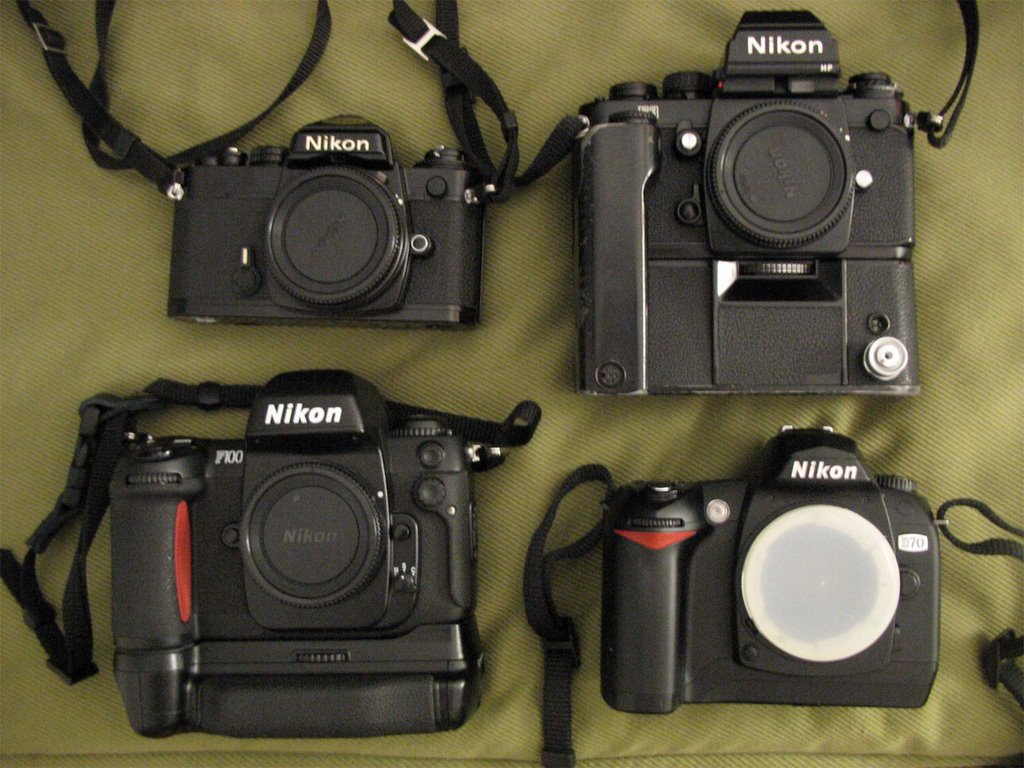
My most used lenses are the 18-70mm on my D70 and the 50mm coming in a close second. For occasions, I usually pick either the 12-24mm or the 24-120mm but not both. For travel, I usually bring these two lenses or if I am really travelling light, just the 18-70mm. On occasion, I have brought both my F100 and D70 on a trip, in these cases, I will mount the 24-120 on the F100 and the 12-24 on the D70 however the 12-24 will still work with the F100 from 18mm onwards. I have only brought the 70-210mm on a trip once and even then hardly used it. My 80-400mm is my "zoo" and birding lens and the 105mm is my product shot lens. Which leaves me with the 24mm, 50mm and the 85mm. These primes are light, portable and fast and I use them when I want to test my creativity in shots and also indoors.

My MF kit - I ran out of film in March after Europe so I havent been shooting much, however, I tend to use the FEs more than the F3 for some reason, maybe its because of their light weight. My most used lens in the MF kit is probably the 35mm however, the picture quality of the 75-150 leads me to keep that in the bag as well.

I have had these lenses for some time and at no time have I felt that I needed anything more. Of course, I lust for better versions of the lenses I have e.g. 17-35mm f2.8D to replace my 20-35mm, 85mm f1.4D to replace the f1.8 version that I have, 70-200mm f2.8G VR to replace my 70-210mm etc and so on, but my limited shooting just doesnt justify getting better lenses. These are also heavier and I prob will never bring them out for travel etc.


In time, I want to add a small pair of Nikon Monarch 8x42mm binoculars, and I might get a D300 (can reuse CF cards from the D70).

Tuesday, July 10, 2007

Which metering to use on Nikon DSLRs

1. Matrix metering - I use it most of the time unless there are areas of high contrast in the picture. Might not work well when the image has mostly light or dark areas.

2. Center weighted metering - I understand what center weighted metering is (i.e. it takes the exposure reading from roughly 70% at the center of the scene) but I have never understood why it still exists in modern Nikon DSLRs. It seems like a legacy mode (pre-FA) before matrix metering existed. People suggest to use this for portraits or when the target is in the middle of the frame but Matrix metering isnt dumb anymore and wont give you those black faced/bright landscape shots often anymore. You should activate your fill-in flash in these situations anyway. One explanation when this mode still exists is to use it when the matrix meter tries to be too smart or is fooled to giving the wrong exposure you want. My solution is to use spot metering in these cases.

3. Spot metering - use it when you want to tell the camera which area of the scene you want to take a reading from. On most Nikons, this still relies on the center sensor. IMHO, this mode is the most important of all and all cameras should have it together with a manual exposure option. It should be possible to take all your shots using spot metering. You just have to select a target that is middle grey (18% grey) to get a balanced exposure. A good tip I use is to meter from the blue sky as often as possible.

Friday, June 29, 2007

Why I buy Nikon over other camera makes

  1. Nikon is one of the only camera manufacturers to have retained a common lens mounting system throughout all these years, the venerable F-Mount (ever since 1959 with the Nikon F. For more info click http://en.wikipedia.org/wiki/F-mount). I would stick to Nikon for this reason alone. This means I can use lenses dating back to the 1980s such as the E-series 75-150mm f3.5 on my 3-year old D70 (yes, of course you will lose metering but who cares with the ability to preview shots instantaneously). Which makes a huge difference in preserving the longevity of your system.
  2. Nikon is one of the only camera manufacturers that still innovates and produces great film SLRs such as the F6. The legacy of photography is film. All photographers should remember this.
  3. Nikon is the one of the only camera manufacturers who still persists in innovating with their products. As an example, check out the Nikon SU-800 and SB-R200 Macro Flash system (available as a set as the R1C1 http://www.nikonusa.com/template.php?cat=1&grp=4&productNr=4803) which replaced the slightly clunky Sb-29s.

Saturday, March 04, 2006

"IDEAL or REQUIRED" lenses for Nikon shooters?

There's always been a lot of talk in the Nikon fraternity about the trinity of lenses - meaning the trio of f2.8 lenses, namely the 17-35mm, 28-70mm and the 70-200mm VR. These cover the focal range of wide, normal and telephoto with supposedly superb sharpness and color but at nearly SGD$7000 aren't exactly cheap. I say supposedly since I dont own any of the trinities... :)

But frankly, these three lenses might not be the best at shooting in certain situations e.g. for macro, street shooting, birding and portrait shots. They are great for what can be classified as general purpose shooting, things like landscapes, holiday shots, family, sports and wedding shooting.

So what can be classified as a set of practical and "ideal" set of lenses for a Nikon user to cover almost any situation a photographer will face? Well, I can give you the standard reply that it "depends on what you shoot" but that would be copping out! I will simply make the assumption that you are like me - an amateur shooter - someone who takes pictures of a wide spectrum of subjects - and just wants to be prepared for any occasion. I will also make the assumption that most people do shoot both film and digital and that you DO have a budget! As a result, I have attempted to choose lenses with a budget of about five thousand Singapore dollars. Now that may seem a lot, but it will be approximately be the price of a decent Nikon DSLR (I recommend the D70s, if you can afford it the D200), film SLR (I recommend the the F100 whole-heartily). I have focussed (pardon the pun) on AF lenses and will save the AIS lenses for another post...

Wide lenses (for going wide)
  • Nikon 12-24mm DX F4. This would be the most expensive lens in the arsenal and to me is the essential choice to cover the wide angle if you are using a digital SLR with a 1.5x crop of a 35mm frame. Some people might say that the 17-55mm would be a better choice but since 17mm is hardly wide enough (25mm in 35mm terms) and this lens is much more expensive than the 12-24 (around SGD$2,000 when I last checked), I hesitate to recommend it. I use the 12-24 frequently whenever I travel, because it can capture such dramatic landscapes, and to a lesser extent for parties, weddings and gatherings). Costs around SGD$1375.
  • Nikon 20mm F2.8. The 12-24 lens is great choice for your digital body, but what about your full frame film body? To get the 17-35mm would be overkill; such a short range and at more than SGD$2000 it would blow most people's budgets in a hurry! C'mon, we all know a plasma TV would get more use than this lens! The MOST I would ever spend on a lens is SGD$1500 and that would be stretching it. As such, I would heartily recommend the 20mm Nikkor. Much lighter than the trinity zooms and 20mm is plenty wide enough for most people. Costs around SGD$700.

Normal lenses (for going fast and simple)

  • Nikon 50mm F1.8. This lens is a no-brainer, doing double duty for both digital/film and can be used as a portrait lens or a great walkabout lens. Sharp too with nice bokeh at large apetures! For a low light lens, it has no parallel except for its F1.4 brother ($$$) and the 85mm F1.4 ($$$$$+). Cheap, light and you wont even know it was in front of your cam. Focusses fast too. Costs around SGD$160.

Mid-range Zoom (all-purpose/travelling lens)

  • Nikon 18-70mm DX F3.5-4.5. Now most people would tell me to get the 18-200mm DX VR. That is an attractive option but at more than SGD$1200 it is a lens that is a wee bit overpriced. After all, a mid range lens is supposed to be reasonably cheap! This lens is actually a super underpriced lens that performs very well for digital SLRs for travelling and all purpose shooting. This is a lens that I recommend getting used since so many people are letting it go at outrageous prices! Available for around SGD$250 used. Recommended for shooting in areas that arent so "safe". However, never mind if u lose it, you can pick another up easily at a steal.
  • Nikon 24-120mm VR F3.5-5.6. This lens has been slammed repeatedly by many people for being "not sharp". Many of these people have never even used this lens. In my informal tests using my 24mm, 50mm and 105mm lenses, I can see no significant differences between these primes and the 24-120mm. Face it, the 24-120mm range is ideal in a single lens especially for film users. Other alternatives most people mention are the are the 28-105mm and 24-85mm (color reproduction for the Japan version of this lens is fantastic though), which are good choices but with no significant advantages over the 24-120mm. Great for both digital and film use and again, I recommend that you get this used at around SGD$600-700.

Telephoto lenses

  • Nikon 80-200mm F2.8. This lens is another no-brainer. Excellent photo quality and can be used for general sports photography, landscapes and for portraits. The only reason not to get this lens is because of its weight (about 1.5kg) and size. But unless you are going somewhere that has stuff like whale watching on the agenda, the 200mm reach will not be needed much. I guarantee that you WILL NOT bring this on your travels unless the trip is purely for photography. You can get this for around SGD$1350 new.
  • Nikon 105mm F2.8 Micro. This is one of my most favorite of lenses and a must have in my opinion in any Nikon shooter's bags. Great for double duty as a macro lens for all those excellent eBay product shots and also for portraits - don't believe what you hear about this lens being too sharp for portraits... what are these people saying, are they nuts? These people are dumb pixel watchers and silly nit-pickers... Get it new for about SGD$800.

In total, these lenses will bust the budget slightly at around SGD$5300+ but it will serve you well until your wallet recovers. For people with larger wallets, you might consider adding a 85mm F1.8 or a 300mm f4 lens (for birding). After all, you do need to save up for that fancy Gitzo CF tripod with Markins ballhead right??! :)

Sunday, January 08, 2006

UPDATE .. Latest Nikon setup

Over the past few months I have been using the following nikon setup - a 1980s FE and F3 + motordrive, a F100 with batt grip, and most lately a digital SLR D70. Yes, the F80 is gone, sold off to a new owner. Much of my shooting have still been using film although I have been moving slowly to digital.

This shot was taken using my latest purchase - a Canon A610 - the first Canon I have bought ever since my much maligned EOS 700 which I gave away in disgust some years back ;)

Friday, September 02, 2005

Nikon Setup

i have added to my original set of equipment. now have 11 lenses and i think thats prob the end of the lens collection for the time being. am going to be a father soon!! so need to save funds for buying more practical stuff like child seats ;) also pampers! did you know that a baby goes through an average of 8 pampers a day? going by that calculation, that is nearly 250 pieces of pampers a month! well anyway, back to nikon...

my present collection is like this:
bodies - nikon d70, f80, fe
lenses - wide > 12-24dx, 24mm, 35mm
- mid > 18-70, 24-85, 24-120, 50mm
- tele > 70-210, 80-400mm, 100mm
- macro > 105mm
pns - olympus mju-1 35mm, mju-2 35-80mm

i know i know, that is a lot of equipment... but NAS is striking and i want a f100 and a fm3a. figure i can get rid of the f80 after getting the f100. the fm3a is more becos i love manual nikon bodies... i dropped my fe (:....) and nothing more than a few nicks and scratces! these cameras are strong... i also would love to get a mint f3hp but the prices people are quoting are crazy... i tried out some guy's f3hp with md4 and it was like ... WHOA. the sound of the motor drive is fantastic.. but should i get it because of that? this combi weighs a ton also.... maybe get a md-12 and see how it goes first...

Edit.. the F80 is gone.. replaced with F100. will miss one of the softest SLR shutter releases...

Wednesday, April 06, 2005

Nikon FE SLR

The old fogeys amongst us will sometimes venture into manual SLRs and being gadget freaks, will ask, what is the best manual SLR to start with? For starters, most people will say the Nikon FM2 - "it operates without batteries" they say. Some would recommend the Nikon EM - this is pretty cheap and dandy. The richer folk would say - get the FM3A - but at USD800 for a used copy, this isn't a cheap option. Not me, I would tell you to get a FE.

The Nikon FE is the forgotten cousin of the Nikon FM/FM2.

It was launched in 1978 and it is much cheaper than any version of the FM2 or FE2 that you can find in the used camera market today.

Most people snap up FM2s because of the Titanium shutter (FM2n) and the ability to work without a battery. However, they forget one thing, metering is lost without a battery. Which is where the Nikon FE comes in. This is a camera that is the equivalent of the FM2 when a battery is inserted. With the battery removed, the FE is only capable of shooting in M90 mode - which means it can be triggered with a shutter speed of 1/90s. Not perfect, but good in a pinch. The Nikon FE uses 2xLR44 batt.

I bought my 2 FEs (one black, one chrome) at a bargain basement price of 120+ US dollars each a couple of years ago.

They work perfectly even though both are around 25 yrs old and I suspect they will keep on running longer than me.

The best thing about the FE is that it is an SLR that is pocketable and the feel of using one is magical. It reminds one in this digital age what it means to BE a photographer. To slow down, compose, to meter carefully, hold your breath and squeeze the shutter release oh so gently to get the shot. Now how many DSLR owners do that nowadays? Most shoot in blazing 5FPS in full auto mode.. And the sound of that shutter... utterly mechanical in nature with a nice solid "click". Not a uninspiring "thack" that I heard while using my colleague's Canon 30D.

The bad thing about the FE is that is uses film.

Oh, not the loading part. Loading a roll of film is an incredibly satisfying experience. It feels the same as loading a gun (or a PEZ dispenser) in some ways. Popping a can of film, you get a whiff of the film chemicals which is familiar and organic in a way. You have then to pop the film back of the FE, insert the film canister and insert the film leader into a slot of the camera's takeup spool making sure the sprockets align. You then close the film back, set the film ISO using the ISO dial and you are ready to go. Fire off a few frames (make sure you choose a fast shutter speed like 1/125s) until the avail frames display shows "0".

Rather, its the fact that developing film requires you to go to the store for processing and most people would get a 4R printout (matt or glossy, ma'am?). The resulting printout reflects how that store calibrates their equipment and unfortunately, some are WAY off in their calibration. This means color casts, reds that are too red and greens that are artificial. The papers that these shops use make a difference as well. I would recommend all film users to get their store to just process the film and scan the negatives/positives through a proper film scanner. Once the photos are scanned, treat them in the same way as your digital images. Of course, all this takes time but then, whats time when you want to appreciate photos and color and light?

Wednesday, August 25, 2004

Nikon lens choices

Some of my thoughts on Nikon lens choices for a ....

Film based SLR

street photography - 50D f1.8, 85D f1.8
general - 28-105D, 24-85G
primes - 24, 50, 105

recommended set - 24-85 f3.5-4.5G, 80-200 f2.8D, 50mm f1.8D, kenko teleplus pro 2x, close-up filter set.

Digital SLR

recommended set - 18-70 f3.5-4.5G, 80-200 f2.8D, 50mm f1.8D, kenko teleplus pro 2x, close-up filter set.

Wednesday, June 02, 2004

Nikon D70 DSLR

After so long.. and disposing of my c5060, I got a new d70 today. super excited... from what it looks the cam is a blast. Excellent battery life with over 500 shots per charge, and fast shooting makes a large difference from my previous cams.

It comes with a 18-70mm lens.. with the d70's 1.5x multiplier it will be 28-105.. same as my old c5060.. which i sometimes miss bcos of its handiness. It just felt good in the hand. my plan next is to get a longer tele zoom..

UPDATE on 13 may-> i got a 70-210 lens to go with the d70. also a ir remote and some cleaning equipment